


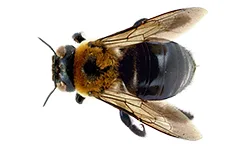
Carpenter bees bore perfectly round, dime-sized holes into untreated wood — eaves, decks, fascia boards, and fences — to build nesting galleries. While they rarely sting, repeated nesting can weaken wood and lead to costly damage over time.
Male carpenter bees are territorial and will hover aggressively near nests, which is often mistaken for a sting risk even though males can't sting at all.
Signs You May Have Carpenter Bees
- Perfectly round, 1/2-inch holes in exposed wood
- Sawdust-like debris (frass) beneath holes
- Yellow-black bees hovering near eaves, decks, or fences
- Staining around entry holes from bee activity
Our Treatment Approach
We treat active nesting galleries and exposed wood surfaces to eliminate current activity and discourage new nests. We'll also point out conducive conditions — bare, untreated wood — so you can reduce the chance of carpenter bees returning.

call us any time